I love the silent film era. I won't say I'm a connoisseur, but I have a deep fondness and appreciation of the aesthetic of silent era cinema. To watch a silent film is to look through a window into another time. Though silent films were produced from 1888 until 1935, the era was really in its prime for the first quarter of the twentieth century. While there are exceptions, those produced in the nineteenth century were, in my view, still a product of a developing art form, and those produced in the last 10 years or so of the era were beginning to transition into more modern cinema.
Many of the producers and directors of the silent era are largely forgotten by modern audiences, if they were even known in the first place. Some may recognize names such as Cecil B DeMille or Hal Roach, but such a prolific innovator as Georges Méliès or the great expressionist Robert Wiene would mostly bring blank stares when mentioned to a contemporary movie-goer. Those who do not respect cinema, simply look at this first frontier of the art form as dated or quaint in comparison with today's impossibly fast paced eye candy. For those who know, however... For those who understand and appreciate this form of art, even in its infancy, the films of the silent era allow us to be observers in time, transported by the art itself, as no other form of art can accomplish.
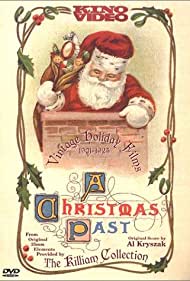
Every year around Christmas, when I can find the time, I like to look at a particular collection of silent films. I have a DVD called A Christmas Past that contains nine silent era films from 1901 through 1925, all relating to the Christmas holiday. This collection embodies the Christmas holiday spirit for me like no other film can. With the flickering of eighteen frames per second tricking your mind into believing you are relaxing by a warm fire, an the masterful score by Al Kryszak, whose festive violin and peaceful, perhaps even haunting, handbells and piano, bring your mind back to not only another time, but another way of life. The films and the score fit together with such perfect precision, one might even for a moment believe it to be hand crafted by elves with Christmas magic at their command.
This magical sleigh ride begins in 1901 with a short called A Holiday Pageant At Home. Viewers find themselves at home with this family on the screen, as the children put on a little Christmas play for their parents. The person who made this film and those acting in it are lost to time, which makes this even more interesting. This may be an actual family, though this does appear to have been filmed on a set rather than in their actual home. Perhaps this is a holiday tradition with this family that someone decided to capture on film. We don't know, we are just observers, and the Ghost of Christmas Past beckons us to leave this family and move on to the next film.
Forward to 1906 we go, to a film called A Winter Straw Ride. Here we find a group of women taking a hayride through the snow. It is simply people enjoying a winter environment, complete with snowball fights. There is no acting involved here, really. It's as though they were instructed to go outside and have a good time. Here too, we feel like an observer from another time, though apart from their clothing, we might be watching a video of the sort that someone would record with their mobile device. It's home video, Edison style.
These first two films, while not any sort of ambitious film making, are superb openers for this collection. These capture the basic, essential elements of the holiday season: family, friends, and fun. As you watch these people from another time, you can't help but wonder what lives they lived. These were people participating in a new art form at the beginning of a new century with so much history still ahead of them. How were they affected by the wars? The depression? Especially the children. Did they have the faintest idea that this little slice of their lives would be a part of someone's holiday tradition one hundred years in the future? So many questions, but the Ghost of Christmas Past beckons us forward again.
The next two films in this collection are similar in nature to one another. First there is A Trap For Santa Claus, from 1909, directed by D.W. Griffith — yes, Birth Of A Nation D.W. Griffith. This is the first film in this collection with a real narrative. After falling on hard times, a desperate father leaves his family. His wife later inherits a fortune, and on Christmas eve, while attempting to burglarize their house, he gets caught in a trap the kids made in order to catch Santa. It's a nice, serendipitous Christmas story. It's less of a direct window into the past than the last two films, but it gives you a feel for how desperate things could get back in those days.

Next, Harold M Shaw directs A Christmas Accident. This story from 1912 is basically a haves and have-nots type of story, in which a mix-up from the grocery delivery brings the two families together. It's easy to relate to the story in some ways, but perhaps not so easy to put a modern spin on it. I don't know much about the historical accuracy of this, but in the present day, I don't know of many wealthy families living next to a poor family in adjoining houses with a common back yard.
Many of us struggle financially, especially around the holidays, but these two films illustrate the extent of the desperation poor families experienced in the days before the social safety nets we have now. They also illustrate how the rich vs poor dynamic has always existed in this country. We like to think of those "good old days" when the nation was young and everything was plentiful, but that wasn't the reality. The working class still struggled, the wealthy still looked down on the poor, and people were driven to desperate measures. The fact that it took the Christmas spirit to bring these estranged classes together shows us that in some ways nothing has changed.
The next two films, again, are similar to one another. There is action, romance, crime drama, and multiple Santas. The Adventure Of The Wrong Santa Claus, the first of the two films, is actually part of a series called Octavius, Amateur Detective. This film seems to be the 1914 equivalent of a Christmas episode from a television series. The following film, Santa Claus vs. Cupid is not a part of any series of which I am aware, but follows the same themes. These are less of a window into the past than the other films, but more of a look into what made for popular entertainment. It's interesting to see that both of these crime drama type films deal with small time stuff like theft and burglary, though it is possible that they intentionally decided to keep it light, as these were Christmas themed stories.
 Next comes a favorite of mine. Forward we go to 1925 with a film simply titled Santa Claus. Two children wake up to find Santa delivering their gifts, and oh, the questions they have for jolly old Saint Nick. Santa tells them all about life at the North Pole. This is a sort of quasi-nature documentary, as we see footage taken in Alaska including Inuit people, walruses, reindeer and a polar bear. Jack Frost makes an appearance that is unintentionally comical, as does the Easter Bunny. It's a wonderful Christmas fantasy film for children. There is one rather ominous part though. Santa tells the children of a bad elf called Hard Times, who sometimes upsets his sleigh and causes presents to get lost and some children won't receive any gifts. He did not encounter him this year, Santa tells them. This film was made five years before the Great Depression. I think the elf called Hard Times came back with a vengeance.
The first of the final two films in this collection are a 1910 adaptation of A Christmas Carol. As much as I've mentioned looking through a window to the past, in A Christmas Carol, this literally happens. Obviously the Ghost of Christmas Past makes an appearance as well. This is not the most sophisticated adaptation of the classic, but it's an interesting step in its evolution.
Lastly, we see a film production of the poem The Night Before Christmas from 1905. I highly recommend this film as a way to introduce children to silent films. It's a familiar story, and the poem appears on the intertitles. Of special note are the special effects done with miniatures. While they are nowhere near the same level as the model shots used by modern filmmakers, it is endearing nevertheless.
And so I am returned to the present day. A feeling of peace has settled over me. It's quiet inside and out. The Christmas work is all done and it's time to relax. We've earned it. We made it through another year. I go to bed reminded that the same struggles and joys we experience today have been felt by families over a century ago. We have all occupied this same space where we have laughed and cried at the things we've seen. Every year, just as they did, we stop and remind ourselves of who we are and what is important. This is the only gift we can give ourselves that matters. To all a good night.