This is an updated version of an article I wrote several years ago. During that time a book has been published that is full of information on early Rock-O-Rama music. If you have the opportunity and are interested in an in-depth look at Rock-O-Rama punk, I highly recommend the book "Rock-O-Rama - Als die Deutschen kamen" by Björn Fischer. I reference this book heavily in this updated article. This also begins a series in which I look at some of the most bizarre and messed up record labels that have existed. My intention is to keep the installments somewhat chronological, but we'll see what happens.
There are some really bizarre record labels out there. Some famously so, and some infamously so. This is the story of one of the infamous ones: Rock-O-Rama Records. This will be a history in several parts, as the label made some interesting twists and turns along the way in its 25 years.
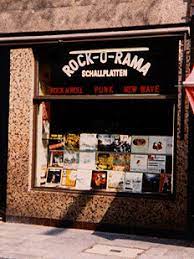
Rock-O-Rama was a West German label born from a mail-order record business and record store owned by a man named Herbert Egoldt. Prior to the first official Rock-O-Rama release, Herbert was known for making bootlegs of old rockabilly records. In the late 1970s, a new sound had emerged, that of punk rock. A newly formed punk band convinced Herbert to release their first record. Herbert undoubtedly saw the potential in that market and so, in 1980, he released the first record on the Rock-O-Rama label from a punk band called Vomit Visions.
Over the next four years, Rock-O-Rama would become one of the more prolific punk labels in West Germany, releasing close to 40 punk records in that time. Eventually the label went in quite a different direction and after 1986 there were very few punk albums released by the label.
In 1993, production of vinyl records was ceased and Rock-O-Rama went exclusively to the CD format. Only a handful of those punk records were reissued on CD, and for the most part, those early records went out of print.
This first installment will focus on the earliest of those releases, covering the years of 1980 and 1981. There were only 7 releases total during that time, four EPs and three LPs, by four different bands. Only one of these bands saw any more of their albums released on this label, but these were all important releases and are sought after by collectors. It all started at the end of 1979...
Vomit Visions — Punks Are The Old Farts Of Today
 In many ways, this record was the perfect start for Rock-O-Rama. The band was formed by roadies and fanzine editors, the record was recorded in a basement on a 2-track recorder over two days, the sound quality was poor, and the cover was exploitative, yet somehow it worked. I wasn't quite 9 years old when this was released, so I don't really know what the punk scene in West Germany was like back in 1980, but it seems like a bold move to come out of the gate with a punk record that says punk is old news.
With this record, Rock-O-Rama inadvertently set the standard for what punk should be. The music wasn't easy to listen to (according to the band, it was not mixed at all), there were no values to be taught by the lyrics, it disparaged its own genre. This record challenged you to like it. Of course, most punk bands did not follow this standard. As awful sounding as this record is, it stands out in a sea of what are basically overproduced lectures on ethics.
The band didn't even really exist as a band apart from when they would get together to make this and their other EPs. There was only to be one pressing of 1,000 units, for which the band was paid 600 DM. The band bought several hundred copies from Herbert to distribute themselves; these copies come with lyric sheets that the band had made. It is quite possible, even probable, that more units were pressed by Egoldt without the band's knowledge.
Vomit Visions did not release any more material on Rock-O-Rama. Herbert wanted to have all the rights to the music, and the band did not want to give up their rights, so they left the label and released their next record on their own. However, this record would become iconic for the label, as this cover would be seen at the top of the back catalog inserts included with nearly every Rock-O-Rama album between 1982 and 1989.
Razors

 There were two more records released in 1980, a single and an LP, both by a Band called Razors. The single contained the song "Low Down Kids" along with two album tracks. The LP was Razors' self-titled album and was the first full length album released on the label.
The Razors were known to Vomit Visions member, Volker Hanreich (aka Hans Wurst), who had been suggesting to Herbert for some time that he should produce a record for them. The Razors were much more commercially viable than Vomit Visions and, realizing this, Herbert would soon make a deal to put their music out. The band received 1,000 DM for the LP and single.
Though they were German, Razors was the most traditional British punk sounding of all the early Rock-O-Rama bands, and would remain so until an actual British punk band would appear on the label in 1983. The Razors LP also holds the distinction of being the earliest release on Rock-O-Rama with a cover variant. The original edition had an adhesive label on the back cover with the songs and some other information on it, while the second edition incorporated that label into the actual back cover printing and gave it a red background.
It is interesting to note that both of the bands on these early releases, German bands on a German label, wrote their songs in English. John Peel suggested in a message to Vomit Visions member, Eric Hysteric, that the German bands should sing in German. It's not clear whether or not this had been relayed to Herbert or had any influence on him, but after those three records, with rare exception all bands would sing in their native languages.
OHL

 In 1981, Rock-O-Rama's first flagship band emerged, Oberste Heeresleitung (OHL), which was the first German singing punk band on the label. The band was fronted by Dirk Windgassen under the stage name Deutscher W., who was a regular at the Rock-O-Rama store in Köln. OHL made a demo tape and Dirk brought it to the shop to be sold. All copies were sold within the week, and based on the strength of the demo, Herbert offered OHL a deal and soon two EPs and an LP were produced.
All material on these three releases were recorded during the same sessions. The first EP contained rejected versions of three songs that would appear on their first LP. The second was a "live" EP that was not actually live, but other rejected takes that were made to sound live by turning up the guitar and turning everything else down. Both of these were limited to 500 copies each.
OHL's first LP is where we get to really hear the early development of Rock-O-Rama's interpretation of the "Deutschpunk" sound. OHL was an influential band to the development of this sound, but don't really get the recognition they deserve for their contribution to the development of that subgenre due in part to the sound quality of their Rock-O-Rama albums. In short: Rock-O-Rama mixes were pretty terrible.
 The first proper LP should have sounded much better than the first EP, but the mix is just sloppy. Perhaps it was due to Herbert's engineer not being familiar with how to mix punk rock, or maybe he just had the wrong idea of how it should sound. Perhaps he just didn't care. Regardless, Rock-O-Rama's punk era was notorious for bad mixes, and there were worse examples to come.
Deutscher W has stated he prefers the sound of the "Live" EP to that of the LP and I have to agree. Given the fact that OHL had barely been together for a year and were quite inexperienced in the studio, they would have really benefitted from having an actual producer for these releases. While the Live EP doesn't exactly sound "good", it has character, even if the character only arrives by accident due to mixing experimentation. Just imagine what could have been with someone there who knew what they were doing.
The Heimatfront LP foreshadowed some of the controversy the label would find itself mired in later on. OHL was a controversial band from the start as their lyrics were against the extreme left as well as the extreme right. This album, while not the first, was the earliest of the Rock-O-Rama releases to be added to the German index of youth endangering media, in particular, the songs "Kraft Durch Freude", "Deutschland", "Kernkraftritter", and "Wir Sind Die Unreparierten". Though the offending lyrics in these songs were taken out of context, the band didn't respond to the indexing request as the band was not active during this time, in 1987, and Deutscher W felt it only served to promote the band further.
Rock-O-Rama began a standardized numbering system at this point. All of their records prior to the OHL EP used an RRR prefix, but the numbers that followed didn't make any obvious sense. The first three records used RRR 0801, 45000 and 80000, respectively; the first one was intended to have the release year incorporated into the number and the other two were intended to have the format at the beginning — 45 for the single and 80 for the LP. With the OHL EP the catalog number was simply RRR 4 and went more or less sequentially after that until the run finally ended in 1993 with RRR 138. These records also introduced the short-lived standard of the yellow center labels. Only a small number of records used these yellow labels before the black center labels would become the standard.
Cotzbrocken
 The final Rock-O-Rama offering from 1981 was from a band called Cotzbrocken, and it's just... not good. I don't know anything about how this band got together, but if you told me that Herbert pulled them off the street into a studio and handed them instruments and gave them an hour to come up with a dozen songs to record, I would believe you. That's all I'll say about the music itself. However, even though it's not good, I can't bring myself to hate it either. It has a certain low-brow charm to it I guess.
Despite the completely unremarkable music, the record holds a significant spot in Rock-O-Rama history. This was the first time that the label's previous productions were advertised in the packaging. The back cover contains small images of the Rock-O-Rama back catalog. Within the next few releases, this would be printed on an insert sheet included with the records.
One of the reasons Rock-O-Rama is of such interest to collectors, is that each record has a list with pictures of the entire back catalog. This practice stopped around 1990, but while it lasted, it worked. If you were familiar with the album covers, you would immediately recognize one as you were flipping through records at a record store.
There are a few other points of interest about this record. First, the band logo is a sticker on the album cover; not all copies of this record have the Cotzbrocken sticker on it. Second, the center labels have the band's logo printed on it, both the plain logo in the middle, and some drawing of a hand and a fist, of which I am not certain of what it is supposed to represent. Third, this album also wound up on the youth endangering media index, which is probably the only reason anyone bothered to bootleg this album later on.
For the indexing, this LP was a victim of circumstance. With the label going full speed into right-wing territory in the mid 1980s, extra scrutiny was given to the older releases. Cotzbrocken wasn't a right-wing band, but their lyrics were unfocused. While OHL had an anti-extremist message in their songs, Cotzbrocken's lyrics were more of a general airing of grievances, some of which could easily be taken the wrong way, thus the album was indexed over four songs that were thought to promote racial hatred and violence.
Looking Ahead
The Rock-O-Rama label ended it's first two years with seven records under its belt and one strong band on its roster. OHL would go on to release several more albums with Rock-O-Rama, while Vomit Visions and Razors went their separate ways and Cotzbrocken just went away. None of these records ever saw an official release on CD, though the OHL songs from the LP were all included on the CD reissue of their second LP. The Cotzbrocken album saw a bootleg CD edition in 1998, and the Razors material and the OHL EPs were included on some semi-official CD releases by other labels, all sourced from the respective records.
The next two years would see a lot of bands come and go, much like the first two. Some bands survived their Rock-O-Rama experience, many did not. You have to keep in mind that, among other things, Herbert Egoldt was a businessman. He saw a market to exploit and exploit it he did, and he cut many corners to do so. In the next installment, we'll take a look at Rock-O-Rama's golden age of punk exploitation.